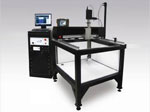
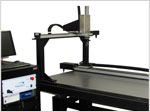
TecScan's advanced Phased Array Ultrasonic Immersion Scanner is designed to meet and exceed the inspection requirements of the aerospace industry. By combining the focusing and multiplexing capabilities of Phased Arrays technology with the accuracy of our immersion scanners, an advanced, complete and powerful ultrasonic inspection solution is created. Whether your application requires rapid coverage of large areas, inspection solutions for complex geometries or increased ultrasonic penetration, TecScan's Phased Array ultrasonic Scanner will meet your challenge.
Table-Top scanners
TecScan offers a completely integrated solution incorporating our Table-top scanner, an industrial enclosure housing all the required electronics, a workstation as well as our TecView™ software package.
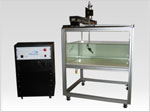
Automated Flaw Detection Immersion Scanner
TecScan’s automate flaw detection immersion scanner is a five axis, lightweight Immersion Scanner designed for laboratory environments and NDT training purposes. Built with Aluminum structures and a ½” Acrylic tank, this scanner is equipped with 2 automated axes (X & Y), a manual Z axis and a manual Gimbal-Gimbal manipulator. The Immersion scanner is specifically intended for laboratory testing and represents an automated extension to any off the shelf flaw detector. The accurate probe displacement provided by the automated X and Y axes along with the fine manual adjustments of water path and probe orientation of the manual Z-axis and Gimbal-Gimbal manipulator enable precise and repetitive probe positioning for flaw detection. With the replacement of manual probe manipulations by encoded automated axis, accurate defect sizing can be performed.
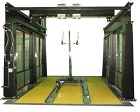
Squirter Gantry systems
TecScan’s NDT Ultrasonic Gantry Systems are industrial Squirter scanners designed for nondestructive quality testing and raster scanning of large structures and parts. The Gantry Systems are usually composed of an Industrial Mechanical Scanner and a Control Room/Workstation.



























 현재위치 : 제품소개 >